uploaded 1 month ago
C++ MIDI 2.0 platform: a C++17 callback-first wrapper that bundles the portable midi2 C99 core. Covers UMP transport (M2-104), MIDI-CI with Appendix E (M2-101), Property Exchange Subscribe/Notify, Profile Configuration, Process Inquiry, Flex Data, and Bit Scaling (M2-115).
Readme
# midi2cpp
**C++ MIDI 2.0 platform. An idiomatic wrapper over the midi2 core. Build MIDI 2.0 devices, hosts, and bridges.**
*C++17, callback-first, static-by-default, bundles midi2, MIT.* From DIY to professional products.
[](https://github.com/midi2-dev/MIDI2.0Workbench)
[](LICENSE)
[](https://en.cppreference.com/cpp/compiler_support)
[](https://midi.org/specifications/midi-2-0-specifications)
[](#install)
---
## The library
midi2cpp is the layer where a sketch meets the protocol. Plug a board into the laptop, write one short sketch, flash, and the device appears on the bus as a USB MIDI 2.0 endpoint with full Capability Inquiry, Property Exchange, and 32-bit resolution.
Underneath, [midi2](https://github.com/sauloverissimo/midi2) (the portable C99 core) handles parsing, dispatch, and reassembly. midi2cpp adds the C++ ergonomics: callbacks, board glue, ready-made USB descriptors. The board does the talking; the sketch tells it what to say.
No external library dependency: the midi2 core is bundled. Transport, clock, and RNG are caller-supplied; no submodules.
## Contents
- [Quickstart](#quickstart)
- [What the library offers](#what-the-library-offers)
- [Three shapes](#three-shapes)
- [Boards](#boards)
- [Recipes by build system](#recipes-by-build-system)
- [Install](#install)
- [Arduino IDE](#arduino-ide)
- [PlatformIO](#platformio)
- [ESP-IDF component](#esp-idf-component)
- [CMake FetchContent](#cmake-fetchcontent)
- [Git submodule](#git-submodule)
- [Manual vendor](#manual-vendor)
- [API at a glance](#api-at-a-glance)
- [Architecture](#architecture)
- [What this library is not](#what-this-library-is-not)
- [Sponsor](#sponsor)
- [About](#about)
- [Specifications and trademarks](#specifications-and-trademarks)
- [License](#license)
## Quickstart
In MIDI 1.0 a note has 128 velocity levels, and bending one note of a chord bends the whole channel. MIDI 2.0 gives every note 65,536 dynamic levels, its own pitch bend, and its own controllers. This is what that looks like:
```cpp
#include <midi2cpp.h>
using namespace midi2;
m2device midi;
// Outbound UMP: one line per board. TinyUSB shown; see the recipes below.
size_t plat_write(const uint32_t* words, size_t count) {
return tud_midi2_n_ump_write(0, words, count);
}
void setup() {
midi.setWriteFn(plat_write);
midi.begin();
}
void loop() {
// A C major chord, each note with its own 16-bit dynamic.
midi.noteOn(0, 60, 0x8000); // C4, mezzo-forte
midi.noteOn(0, 64, 0x6000); // E4, a touch softer
midi.noteOn(0, 67, 0xC000); // G4, singing on top
// Bend only the G. The C and the E hold still.
for (uint32_t bend = 0x80000000; bend < 0x90000000; bend += 0x00800000) {
midi.sendPerNotePitchBend(/*group*/ 0, /*channel*/ 0, /*note*/ 67, bend);
delay(15);
}
// Open the same note's own brightness (per-note controller 74).
midi.sendRegPerNoteController(0, 0, 67, 74, 0xFFFF0000);
midi.noteOff(0, 60);
midi.noteOff(0, 64);
midi.noteOff(0, 67);
delay(1000);
}
```
Receiving is symmetric: 49 typed callbacks, one per message kind.
```cpp
midi.onNoteOn([](uint8_t ch, uint8_t note, uint16_t vel16) {
// vel16 spans the full 16-bit range; MIDI 1.0 inputs arrive upscaled.
});
```
Every callback also has a verbose overload exposing Group and the MIDI 2.0 attribute fields; see [API at a glance](#api-at-a-glance).
`midi2cpp` is platform-agnostic: it parses, dispatches, and assembles UMP, and leaves USB transport, clock, and entropy to the caller. The entire platform contract is four hooks (`setWriteFn`, `feedRx`, `setNowFn`, `setMounted` + `setAltSetting`); anything left unset degrades safely. [`hello-midi2-arduino`](examples/hello-midi2-arduino/hello-midi2-arduino.ino) is the complete compilable baseline, including the MIDI-CI responder package (Discovery, Profiles, Property Exchange, Process Inquiry) validated against the MIDI 2.0 Workbench, and the [board recipes](#boards) wire real transports.
## What the library offers
- USB MIDI 2.0 device, host, or both, depending on the board.
- 49 typed UMP callbacks: notes, CCs, RPN/NRPN, per-note expression, Flex Data, Stream messages.
- MIDI-CI out of the box: Discovery, Profile negotiation, Property Exchange (with Subscribe/Notify), Process Inquiry.
- Static-by-default. The hot path is allocation-free; init-time `new` only inside `m2bridge` for the per-slot tables. Fits a Cortex-M0+.
- Pay-as-you-go: only the modules called by the sketch end up in the binary.
## Three shapes
| Class | Role | Status |
|-------|------|--------|
| `m2device` | USB MIDI 2.0 device, board enumerates as a MIDI peripheral on a host (DAW, OS) | **available** |
| `m2host` | USB MIDI 2.0 host, board exposes a USB-A port and reads attached MIDI devices | **available** |
| `m2bridge` | Host + device, both ports active; route, group-rewrite, dynamic FB names, MIDI 1.0 alt 0 uplift | **available** |
Same callback API across the three. `m2bridge` composes `m2device` + `m2ci` + `m2host` and adds a multi-slot Stream Discovery responder, raw UMP forward with per-slot group window rewrite, and an internal `ByteStreamConverter` per slot for MIDI 1.0 alt 0 upstream devices. Slots are bound to device identity, so Function Block numbers stay stable across boots. Reference platform glue at [`examples/esp32-p4-devkit-bridge2-midi2`](examples/esp32-p4-devkit-bridge2-midi2/) (3 slots, ESP-IDF dual PHY), [`examples/adafruit-feather-rp2040-bridge-midi2`](examples/adafruit-feather-rp2040-bridge-midi2/) and [`examples/waveshare-rp2350-usb-a-bridge-midi2`](examples/waveshare-rp2350-usb-a-bridge-midi2/) (single slot, PIO-USB host).
## Boards
Validated on real hardware against TinyUSB upstream. midi2cpp is one of several integrations of the underlying [`midi2`](https://github.com/sauloverissimo/midi2) C99 core; concrete recipes for boards that use midi2cpp ship under [`examples/`](examples/), one per role (device, host, bridge). The **Notes** column links each recipe and flags any board-specific build requirement.
| Board | MCU | Device | Host | Bridge | Workbench | Transport | Notes |
|-------|-----|:-:|:-:|:-:|:-:|-----------|-------|
| **ESP32-S3 DevKitC-1** | ESP32-S3 | ✅ | - | - | ✅ | TinyUSB | [`esp32-s3-devkitc-usb-midi2`](examples/esp32-s3-devkitc-usb-midi2) |
| **Arduino Nano ESP32** | ESP32-S3 | ✅ | - | - | ✅ | TinyUSB | [`arduino-nano-esp32-midi2`](examples/arduino-nano-esp32-midi2) |
| **Waveshare ESP32-P4-WIFI6-DEV-KIT** (device) | ESP32-P4 | ✅ | - | - | ✅ | TinyUSB | [`esp32-p4-devkit-usb-midi2`](examples/esp32-p4-devkit-usb-midi2), mandatory `LP_SYS.usb_ctrl` PHY swap |
| **Waveshare ESP32-P4-WIFI6-DEV-KIT** (host / bridge) | ESP32-P4 | - | ✅ | ✅ | ✅ |  TinyUSB | [`esp32-p4-devkit-host-midi2`](examples/esp32-p4-devkit-host-midi2), [`esp32-p4-devkit-bridge2-midi2`](examples/esp32-p4-devkit-bridge2-midi2), experimental coexistence branch |
| **LilyGo T-Display S3** | ESP32-S3 | ✅ | - | - | ✅ | TinyUSB | [`t-display-s3-midi2`](examples/t-display-s3-midi2), full UMP receiver, on-board ST7789 piano roll |
| T-Display S3 AMOLED | ESP32-S3 | ✅ | ✅ | - | - | TinyUSB | uses the library directly, no dedicated recipe yet |
| **Teensy 4.1** | i.MX RT1062 | ✅ | ✅ | - | ✅ |  Teensyduino native + USBHost_t36 | [`teensy41-midi2`](examples/teensy41-midi2) (device), [`teensy41-control-surface`](examples/teensy41-control-surface), [`teensy41-host-midi2`](examples/teensy41-host-midi2), Teensyduino cores + USBHost_t36 forks |
| **Daisy Seed** | STM32H750 | ✅ | ✅ | - | ✅ |  libDaisy native | [`daisyseed-midi2`](examples/daisyseed-midi2) (device), [`daisyseed-host-midi2`](examples/daisyseed-host-midi2) (host), libDaisy fork, STM32 HAL stack |
| **Raspberry Pi Pico** | RP2040 | ✅ | - | - | ✅ | TinyUSB | [`rp2040-midi2`](examples/rp2040-midi2) |
| **Waveshare RP2040 Pi Zero** | RP2040 | ✅ | - | - | ✅ | TinyUSB | [`waveshare-rp2040-midi2`](examples/waveshare-rp2040-midi2) |
| **Adafruit Feather RP2040 USB Host** | RP2040 | ✅ | ✅ | ✅ | ✅ | TinyUSB, PIO-USB | [`adafruit-feather-rp2040-host-midi2`](examples/adafruit-feather-rp2040-host-midi2), [`adafruit-feather-rp2040-bridge-midi2`](examples/adafruit-feather-rp2040-bridge-midi2), Pico-PIO-USB `675543b` |
| **RP2040 Pro Micro (Tenstar Robot)** | RP2040 | ✅ | - | - | ✅ | TinyUSB | [`rp2040-promicro-ump-test-bench`](examples/rp2040-promicro-ump-test-bench), deterministic UMP emitter for Windows MIDI Services testing |
| **Waveshare RP2350-USB-A** | RP2350 | ✅ | ✅ | ✅ | ✅ | TinyUSB, PIO-USB on GP12/GP13 | [`waveshare-rp2350-usb-a-midi2`](examples/waveshare-rp2350-usb-a-midi2) (device), [`waveshare-rp2350-usb-a-bridge-midi2`](examples/waveshare-rp2350-usb-a-bridge-midi2) (bridge), R13 hardware mod for host mode |
| **Raspberry Pi Pico 2** | RP2350 | ✅ | - | - | ✅ | TinyUSB | [`rp2350-pico2-midi2`](examples/rp2350-pico2-midi2) |
| **ESP32-C6-DevKitC-1** | ESP32-C6 |  | - | - | - | BLE-MIDI 1.0 + ESP-NOW | [`esp32-c6-devkitc-multi-midi2`](examples/esp32-c6-devkitc-multi-midi2), wireless (BLE-MIDI + ESP-NOW), no USB-OTG |
| **nRF52840 Pro Micro (Nice!Nano class)** | nRF52840 | ✅ | - | - | ✅ | TinyUSB | [`nrf52840-promicro-midi2`](examples/nrf52840-promicro-midi2), TinyUSB native CMake build |
| **Seeed XIAO SAMD21** | SAMD21 | ✅ | - | - | - | TinyUSB | [`xiao-samd21-midi2`](examples/xiao-samd21-midi2), TinyUSB native CMake build |
| **T-PicoC3** (RP2040 side) | RP2040 + ESP32-C3 | ✅ | - | - | ✅ | TinyUSB | [`t-picoc3-device-midi2`](examples/t-picoc3-device-midi2), on-board LCD visualizer (LovyanGFX) |
| **WeAct RA4M1 64-Pin Core Board** | RA4M1 | ✅ | - | - | ✅ | TinyUSB | [`ra4m1-weact-device-midi2`](examples/ra4m1-weact-device-midi2), board overlay for bootloader-less 0x0 flash |
| **WeAct STM32F411 BlackPill** | STM32F411 | ✅ | - | - | ✅ | TinyUSB | [`weact-STM32F411CEU6-blackpill-device-midi2`](examples/weact-STM32F411CEU6-blackpill-device-midi2), native OTG_FS, CMake build |
**Workbench** ✅ marks a device recipe validated against the official [MIDI 2.0 Workbench](https://github.com/midi2-dev/MIDI2.0Workbench): it completes the self-certification checklist for the features it implements (MIDI-CI Discovery, Profile Configuration, Property Exchange, Process Inquiry, plus the UMP message categories the recipe emits). A blank cell means the recipe has not been run through the Workbench yet, not that it fails.
The library itself carries no external dependencies; a handful of recipes pin theirs. The PIO-USB host recipes (`adafruit-feather-rp2040-host-midi2`, `adafruit-feather-rp2040-bridge-midi2`, `waveshare-rp2350-usb-a-bridge-midi2`) pin [Pico-PIO-USB](https://github.com/sekigon-gonnoc/Pico-PIO-USB) at upstream SHA `675543b`, the merge commit of PR #186 "reduce handshake delay", required for MIDI 2.0 host enumeration over PIO-USB (merged upstream, newer than the latest tagged release 0.7.2; the pin becomes a plain version bump once upstream tags a new release). The Teensy recipes build against two forks carrying code not yet submitted upstream: [`sauloverissimo/cores`](https://github.com/sauloverissimo/cores/tree/feature/usb-midi2-descriptors) branch `feature/usb-midi2-descriptors` (native USB MIDI 2.0 with AS0 + AS1 alt settings, used by `teensy41-midi2` and `teensy41-control-surface`) and [`sauloverissimo/USBHost_t36`](https://github.com/sauloverissimo/USBHost_t36/tree/feature/midi2-host-base) branch `feature/midi2-host-base` (USB MIDI 2.0 host side, used by `teensy41-host-midi2`). Each fork retires when its changes land upstream.
### Recipes by build system
28 recipes ship under [`examples/`](examples/), grouped by build path:
| Build system | Count | Recipes |
|---|:-:|---|
| **Pico SDK** | 9 | [`rp2040-midi2`](examples/rp2040-midi2), [`waveshare-rp2040-midi2`](examples/waveshare-rp2040-midi2), [`rp2350-pico2-midi2`](examples/rp2350-pico2-midi2), [`waveshare-rp2350-usb-a-midi2`](examples/waveshare-rp2350-usb-a-midi2), [`waveshare-rp2350-usb-a-bridge-midi2`](examples/waveshare-rp2350-usb-a-bridge-midi2), [`adafruit-feather-rp2040-host-midi2`](examples/adafruit-feather-rp2040-host-midi2), [`adafruit-feather-rp2040-bridge-midi2`](examples/adafruit-feather-rp2040-bridge-midi2), [`rp2040-promicro-ump-test-bench`](examples/rp2040-promicro-ump-test-bench), [`t-picoc3-device-midi2`](examples/t-picoc3-device-midi2) |
| **ESP-IDF** | 6 | [`arduino-nano-esp32-midi2`](examples/arduino-nano-esp32-midi2), [`esp32-s3-devkitc-usb-midi2`](examples/esp32-s3-devkitc-usb-midi2), [`esp32-p4-devkit-usb-midi2`](examples/esp32-p4-devkit-usb-midi2), [`esp32-p4-devkit-host-midi2`](examples/esp32-p4-devkit-host-midi2), [`esp32-p4-devkit-bridge2-midi2`](examples/esp32-p4-devkit-bridge2-midi2), [`t-display-s3-midi2`](examples/t-display-s3-midi2) |
| **PlatformIO + ESP32_Host_MIDI** | 3 | [`esp32-c6-devkitc-multi-midi2`](examples/esp32-c6-devkitc-multi-midi2), [`esp32-s3-devkitc-host-midi2`](examples/esp32-s3-devkitc-host-midi2), [`t-display-s3-shield-host-midi2`](examples/t-display-s3-shield-host-midi2) |
| **TinyUSB native CMake** | 4 | [`xiao-samd21-midi2`](examples/xiao-samd21-midi2), [`nrf52840-promicro-midi2`](examples/nrf52840-promicro-midi2), [`ra4m1-weact-device-midi2`](examples/ra4m1-weact-device-midi2), [`weact-STM32F411CEU6-blackpill-device-midi2`](examples/weact-STM32F411CEU6-blackpill-device-midi2) |
| **Arduino IDE / arduino-cli** | 4 | [`teensy41-midi2`](examples/teensy41-midi2), [`teensy41-control-surface`](examples/teensy41-control-surface), [`teensy41-host-midi2`](examples/teensy41-host-midi2), [`hello-midi2-arduino`](examples/hello-midi2-arduino) |
| **libDaisy / Makefile** | 2 | [`daisyseed-midi2`](examples/daisyseed-midi2), [`daisyseed-host-midi2`](examples/daisyseed-host-midi2) |
By role: 16 device, 6 host, 3 bridge, 1 multi-transport (BLE + ESP-NOW, no USB PID), 1 deterministic UMP test bench, 1 transport-agnostic starter ([`hello-midi2-arduino`](examples/hello-midi2-arduino)).
## Install
### Arduino IDE
Listed on the Arduino Library Manager. The IDE install path: search the manager, click Install. That is the only library you install; the midi2 core is bundled.
Manual install (mirror, or while the manager index is propagating):
```bash
git clone https://github.com/sauloverissimo/midi2cpp.git ~/Arduino/libraries/midi2cpp
```
### PlatformIO
Published on the [PlatformIO Registry](https://registry.platformio.org/libraries/sauloverissimo/midi2cpp):
```ini
lib_deps = sauloverissimo/midi2cpp @ ^0.7.0
```
Or pin by git tag:
```ini
lib_deps =
https://github.com/sauloverissimo/midi2cpp.git#v0.7.0
```
That is all you need: midi2cpp bundles the midi2 C99 core, so there is no separate `midi2` dependency to install.
### ESP-IDF component
Published on the [ESP Component Registry](https://components.espressif.com/components/sauloverissimo/midi2cpp). Two install paths, depending on whether midi2cpp comes from the registry or lives inside the project tree:
**Via the Component Manager** (recommended):
```yaml
# main/idf_component.yml
dependencies:
idf: ">=5.0"
sauloverissimo/midi2cpp: ">=0.7.0"
```
The midi2 core is bundled inside midi2cpp, so nothing else is declared. `idf.py reconfigure` drops midi2cpp into `managed_components/`.
**As a local component** (useful when iterating on the wrapper):
```bash
# from your IDF project root
git clone https://github.com/sauloverissimo/midi2cpp.git components/midi2cpp
```
`main/CMakeLists.txt` lists `midi2cpp` in its `idf_component_register(... REQUIRES midi2cpp ...)` block. The seven ESP-IDF recipes under [`examples/`](examples/) ship working templates for device, host and bridge roles.
### CMake FetchContent
```cmake
include(FetchContent)
FetchContent_Declare(
midi2cpp
GIT_REPOSITORY https://github.com/sauloverissimo/midi2cpp.git
GIT_TAG v0.7.0
)
FetchContent_MakeAvailable(midi2cpp)
```
`midi2cpp` is self-contained: the midi2 C99 core is vendored in its `src/`, so there is no second `FetchContent` or `find_package` to wire. A standalone midi2 install (for direct C use or other wrappers) coexists with it: a sketch or target that includes only `<midi2cpp.h>` uses the bundled core, and the linker does not pull a separate midi2 copy. If you deliberately link both a bundled and a different-version standalone midi2 in one binary, the linker resolves the core from one of them by link order (a consistent version, not a per-function mix).
### Git submodule
```bash
git submodule add https://github.com/sauloverissimo/midi2cpp.git external/midi2cpp
```
### Manual vendor
Download the [midi2cpp](https://github.com/sauloverissimo/midi2cpp) repository, add `midi2cpp/src/` to the include path, and compile `src/midi2.c` (the bundled midi2 core), `src/midi2_device.cpp`, `src/midi2_ci.cpp`, and the host/bridge `.cpp` files you need alongside the project. One repository, no package manager, nothing else to download.
## API at a glance
```cpp
m2device midi;
midi.begin();
// Inbound: Arduino-style, just the channel, note, velocity.
midi.onNoteOn ([](uint8_t ch, uint8_t note, uint16_t vel) { /* ... */ });
midi.onNoteOff([](uint8_t ch, uint8_t note, uint16_t vel) { /* ... */ });
midi.onCC ([](uint8_t ch, uint8_t idx, uint32_t val) { /* ... */ });
midi.onPitchBend([](uint8_t ch, uint32_t val) { /* ... */ });
// Outbound: same shape, no group prefix, 32-bit values.
midi.noteOn (0, 60, 0xC000);
midi.noteOff(0, 60);
midi.cc (0, 7, 0x80000000);
midi.pitchBend(0, 0x80000000);
midi.task();
```
Async, callback-first, copy-paste-ready. Same shape as MIDI 1.0 Arduino libraries, with MIDI 2.0 resolution underneath.
**Need full spec fidelity?** Every callback and sender has a verbose form that exposes Group, MIDI 2.0 attribute type/data, and other Multi-Group Endpoint controls; see `midi2_device.h`. The simple and verbose forms share storage; the latest setter wins.
## Architecture
midi2cpp: platform layer of a 4-layer MIDI 2.0 stack:
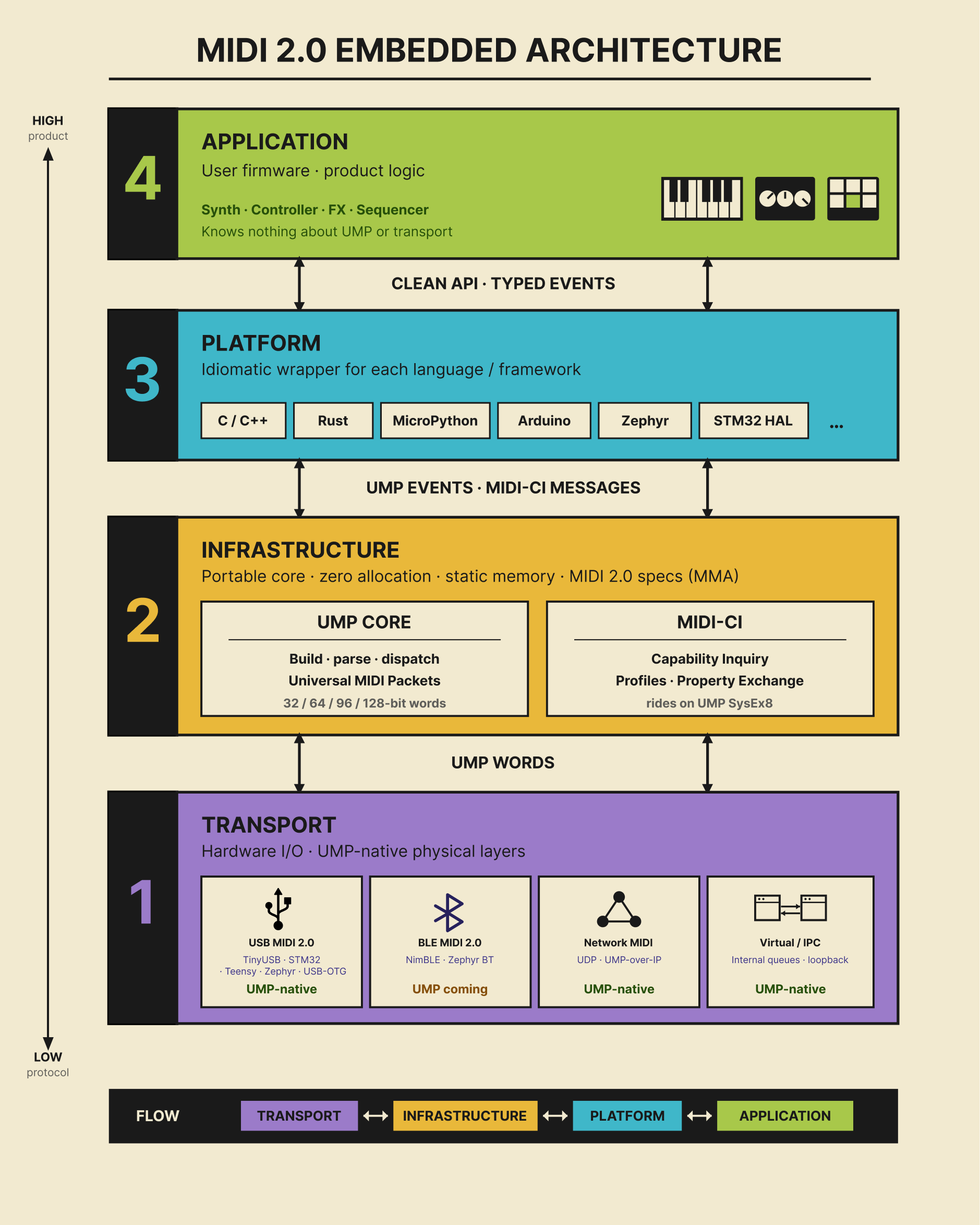
The sketch touches the top. The rest is invisible until needed.
## What this library is not
The boundary is drawn so the wrapper stays focused. A few things deliberately do not belong here.
- **Not a low-level UMP parser.** That is `midi2`. midi2cpp wraps it and adds C++ ergonomics; if a project wants zero-overhead C with no callbacks, linking `midi2` directly is the right move.
- **Not a synthesizer.** UMP arrives, callbacks fire, the sketch decides what to play. Sound generation is application territory.
- **Not a desktop library.** It targets MCU boards. It compiles on desktop for tests, but the API and memory model assume embedded constraints.
- **Not opinionated about transport.** TinyUSB, native USB (Teensy), PIO-USB (RP2350), STM32 HAL (Daisy), BLE: midi2cpp does not bring any of them with it. The sketch wires whichever transport its platform already ships.
## Sponsor
You can sponsor midi2cpp at [GitHub Sponsors](https://github.com/sponsors/sauloverissimo). Sponsorship funds boards for cross-platform validation, spec access, and continued maintenance.
## About
midi2cpp is created and maintained by [Saulo Veríssimo](https://github.com/sauloverissimo). It is the C++17 sibling of [midi2](https://github.com/sauloverissimo/midi2), the portable C99 core, and every recipe in this repository has been validated on the physical board it targets.
## Specifications and trademarks
The MIDI 2.0 specifications referenced here are copyright of the [MIDI Association](https://midi.org) and available at https://midi.org/midi-2-0.
"MIDI" is a registered trademark of the MIDI Manufacturers Association (now MIDI Association). "MIDI 2.0", "MIDI-CI", and "UMP" are terms defined by the MIDI Association in the public specifications.
## License
MIT. Free for commercial and open-source use, in any context.
Links
Supports all targets
Maintainer
- Saulo Verissimo <sauloverissimo@gmail.com>
To add this component to your project, run:
download archive
idf.py add-dependency "sauloverissimo/midi2cpp^0.7.0"
Stats
-
Archive size ~ 68.40 MB
-
Downloaded in total 58 times
-
Weekly Downloads (All Versions)
-
This version: 6 times
Badge
