readme
esp-idf-rc522


This repository contains ESP-IDF library (component) for communication with RFID cards using MFRC522 reader.
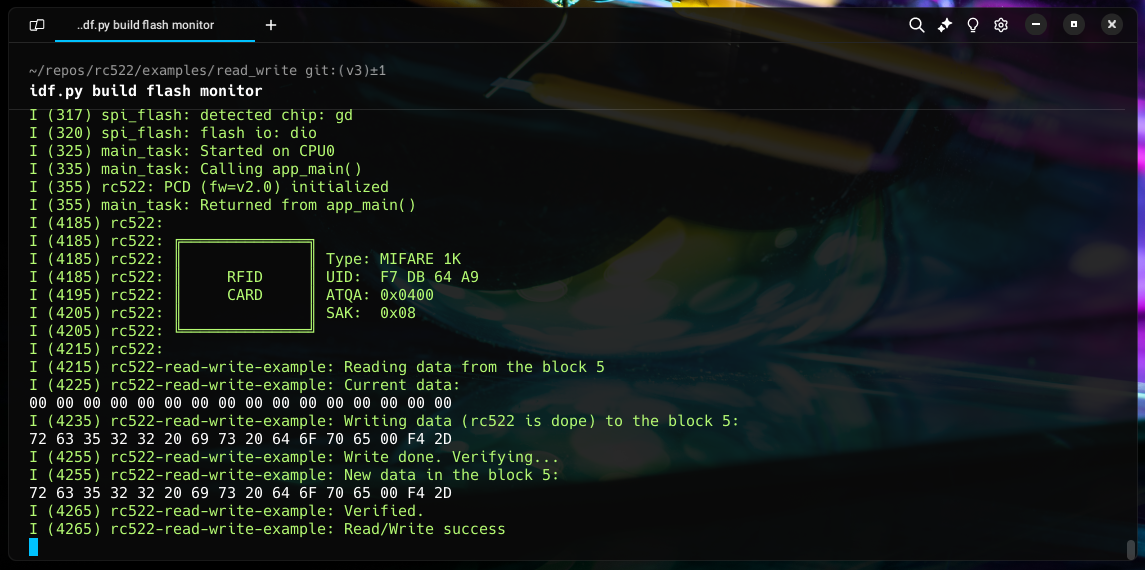
Library takes care of polling the cards and managing the card lifecycle. It also fires events when a card is detected, removed, or when the card changes to any state described in ISO-14443. Additionally, it provides an API for reading and writing to card memory blocks.
Installation
To install latest version of this component to your project, run:
Bash
idf.py add-dependency "abobija/rc522"
Read more about esp-idf component manager in official documentation.
Support
- Full support:
MIFARE 1K,MIFARE 4K,MIFARE Mini - Partial support: Ultralight & NTAG families
- Supported commands:
GET_VERSION,READ,FAST_READ,WRITE,READ_CNT,READ_SIG,PWD_AUTH - Supported features: PICC identification, read/write, page counts, password authentication
- Unsupported commands:
INCR_CNT,WRITE_SIG,LOCK_SIG,AUTHENTICATE,COMPAT_WRITE,VCSL - Unsupported features: signature validation, key authentication, high-level configuration access (raw read + bit-manipulation only)
- Supported commands:
- No support: ISO-14443-4 compatible PICCs, other proprietary PICC protocols
- Communication protocols:
SPIandI2C
See examples for example projects.
Create project from example
Tip
To find more interesting examples (like memory_dump), go to examples folder.
To run basic example, create it as follows:
Bash
idf.py create-project-from-example "abobija/rc522:basic"
Then build and flash it as usual:
Bash
cd basic
idf.py build flash monitor
Pin Layout
Pin layout is configurable by the user. To configure the GPIOs, check the #define statements in the basic example. If you are not using the RST pin, you can connect it to the 3.3V.
Unit testing
To run unit tests, go to test directory and set target to linux:
Bash
cd test
idf.py --preview set-target linux
Then build the project and run tests:
Bash
idf.py build && ./build/test.elf
Security
- Mifare Classic cards use the Crypto-1 cipher for authentication and encryption, which has been broken for a long time. As a result, it is not advisable to use Mifare Classic cards for security-sensitive applications. Instead, consider using Mifare Plus or Desfire cards, which utilize AES encryption.
- Even though block zero, which contains the UID, is typically considered as read-only, there are certain cards known as "magic" or "Chinese magic" cards that can be used to modify the UID. As a result, relying on the UID of a card as a secure identifier is not recommended.
Terms
| Term | Description |
|---|---|
| PCD | Proximity Coupling Device (the card reader). In our case this is MFRC522 module |
| PICC | Proximity Integrated Circuit Card (e.g: rfid card, tag, ...) |
References
- ISO/IEC 14443 Identification cards - Contactless integrated circuit cards
- ISO/IEC 14443-2 Radio frequency power and signal interface
- ISO/IEC 14443-3 Initialization and anticollision
- ISO/IEC 14443-4 Transmission protocol
- MFRC522 MFRC522 - Standard performance MIFARE and NTAG frontend
- AN10833 MIFARE type identification procedure
- AN10834 MIFARE ISO/IEC 14443 PICC selection
- MF1S50YYX_V1 MIFARE Classic EV1 1K
- MF1S70YYX_V1 MIFARE Classic EV1 4K
License
This component is provided under Apache 2.0 license, see LICENSE file for details.
Links
- Homepage
-
Repository
470a66e6ea4aca568a0caf6c69e3885e82b22c6f
Supports all targets
Maintainer
- Alija Bobija <bobija.alija@gmail.com>
License: Apache-2.0
idf.py add-dependency "abobija/rc522^3.3.2"
Stats
-
Archive size ~ 66.29 KB
-
Downloaded in total 2.3k times
-
This version: 278 times
Badge
